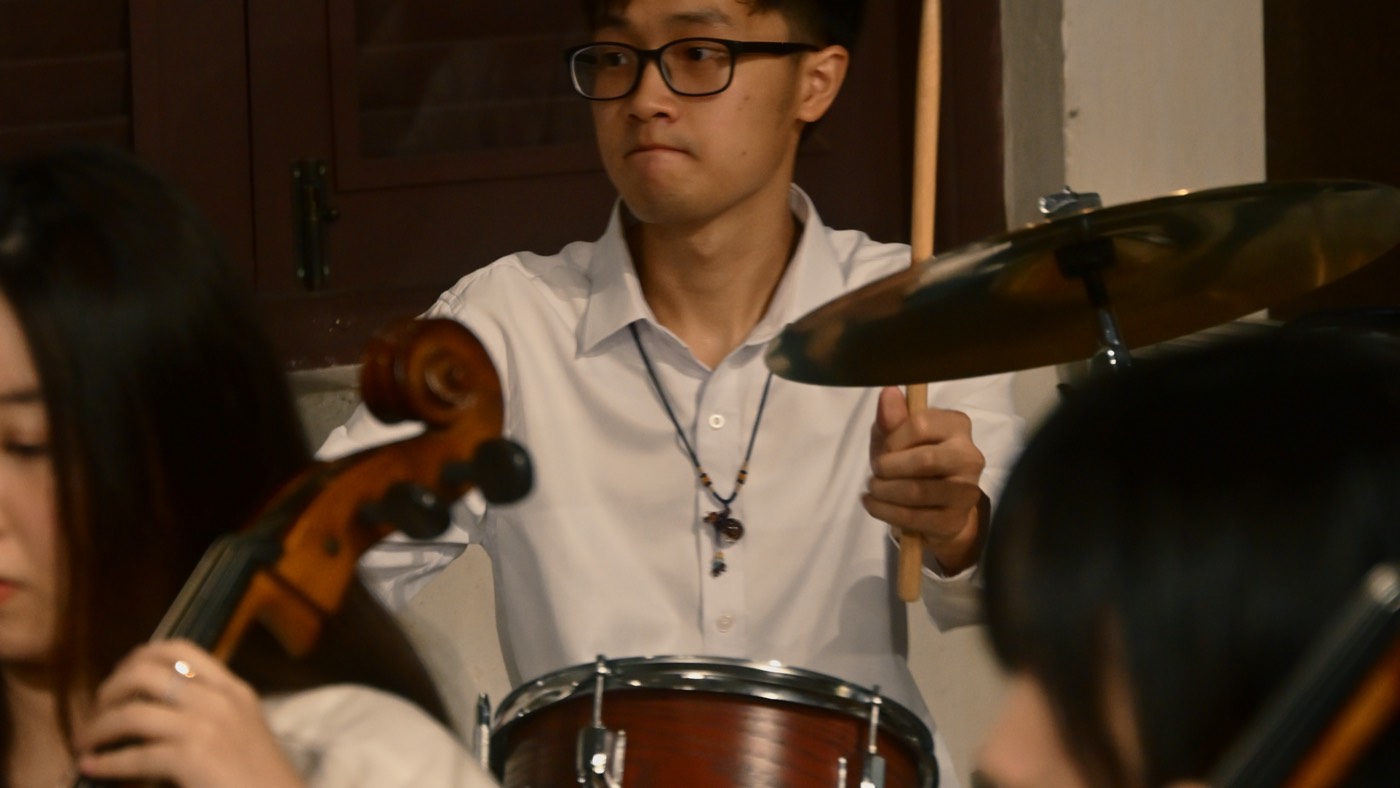
A child asks for drums. The parent pictures a full kit in the second bedroom of a condominium, a neighbour at the door, and a management letter. The conversation usually ends there — which is a pity, because the picture is wrong.
Drumming is the one instrument where what a beginner practises on at home and what they play in a lesson are deliberately different things. Understanding that difference resolves most of the objection.
- Beginners practise on a rubber pad, not a kit. It is quieter than typing.
- The kit lives at the academy. Our drum room is built for it, so the weekly lesson carries the loud work.
- If you do buy for home, buy electronic — and understand that the pedal, not the pads, is what the downstairs neighbour hears.
- We start drummers at seven, for reach and limb independence rather than enthusiasm.
What a beginner actually practises on
For the first several months, a drum student practises on a practice pad — a disc of rubber or gum on a stand, about the size of a dinner plate. It costs very little, packs into a school bag, and produces a dry tap you can comfortably talk over.
This is not a compromise made for the neighbours. It is how drummers are taught. The pad is where stick technique, the rudiments and — above all — timing are built, and those are precisely the things a beginner cannot build while distracted by five other drums. A student who has spent six months on a pad arrives at a kit with hands that already know what to do.
The practical consequence for a family is that the first stage of learning drums asks for less space and less noise than the piano does.
Electronic or acoustic, at home
Eventually a student wants something with more than one surface. There are three realistic options, and the differences matter more than the price tags suggest.
| What you practise on | What it is good for | What the neighbours hear |
|---|---|---|
| Practice pad | Rudiments, stick control, timing. The first six months, and useful for years afterwards. | Almost nothing — a dry tap. |
| Electronic kit | Limb independence, coordination, playing along with music. Volume is adjustable and headphones work. | The pedal through the floor, not the pads through the air. |
| Acoustic kit | Tone, dynamics, the real thing. What lessons are for. | Everything. Commonly measured near the level of a power tool. |
| The studio at the academy | All of the above, at full volume, with a teacher in the room. | Nothing — it is a purpose-built drum room. |
The point families miss is in the third column. An electronic kit is quiet in the air and loud through the structure. Mesh heads absorb the stick, but the kick pedal sends a thud down through the floor slab, and in a KL condominium that travels to the unit below far more effectively than a cymbal ever would.
It is a solvable problem. A low-mass beater, a rubber pedal mat and a riser under the rack — a sheet of ply on dense foam is usually enough — take out most of it. Do that at the point of purchase rather than after the first complaint.
The drum room is the fastest way to settle this question. Book a thirty-minute trial at Pandan Indah or Damai Perdana and see what a beginner actually does. Trial lesson fees apply.
Book a Trial LessonWhy we start drummers at seven
Drums is one of the later starts on our roster — seven, against two for the piano and the ukulele. The reason is physical rather than musical.
A drummer needs both feet on pedals while both hands work. Below about seven, most children cannot sit at a height that keeps the hands comfortable and still reach the kick.
Playing a beat means asking four limbs to do four unrelated things at once. That coordination arrives at its own pace, and pushing it early tends to produce frustration rather than progress.
A drummer holds time for everyone else. Being able to keep a pulse without drifting is the one readiness marker worth testing, and it is easy to test in a trial.
Rebound does the work in good drumming. Hands need enough size and strength to let a stick bounce rather than clamping it, which is what causes the tension we spend months undoing.
A younger child who is set on drums is usually best served by starting elsewhere for a year or two. Piano from two, or ukulele from two, builds pulse and reading, and neither is wasted — the drummers who arrive at seven with a year of piano behind them tend to move quickly.
What the first six months sound like
Month one is a pad, a pair of sticks and single strokes: even, unhurried, both hands equally weighted. Most students find the left hand — or the right, for a left-handed player — genuinely uncooperative, and that is the normal starting point rather than a sign of anything. Ten focused minutes most days will do more here than an hour at the weekend, which is true of practice on any instrument.
By about month three there is a basic rock beat with the hands and the kick together, played slowly, and the first fills. Around month four or five the student can usually play along to a track they chose themselves, which is generally the moment drums stops feeling like homework.
By month six a drummer is not yet good, but they are recognisably playing music, and they have something most beginners on other instruments do not: a reliable sense of time. It is worth remembering that this is the instrument on which a child can accompany real songs soonest.
Frequently asked questions
No. A practice pad and a pair of sticks cover the first several months, and the academy supplies the kit during lessons. Most families buy nothing more for at least half a year, and some never buy a kit at all.
Yes, with an electronic kit and a little care. Use headphones, and isolate the kick pedal with a low-mass beater and a riser — the pedal transmitting through the floor is what neighbours notice, not the pads. A practice pad needs no precautions at all.
For home practice it is genuinely good enough, and for coordination it is excellent. What it does not teach is tone and dynamics, which is one of the reasons lessons are on an acoustic kit in our drum room rather than on a pad at a desk.
From seven. The limit is reach and limb independence rather than interest, so a younger child who is keen on drums often starts on piano or ukulele and moves across at seven with a year of rhythm already behind them.